
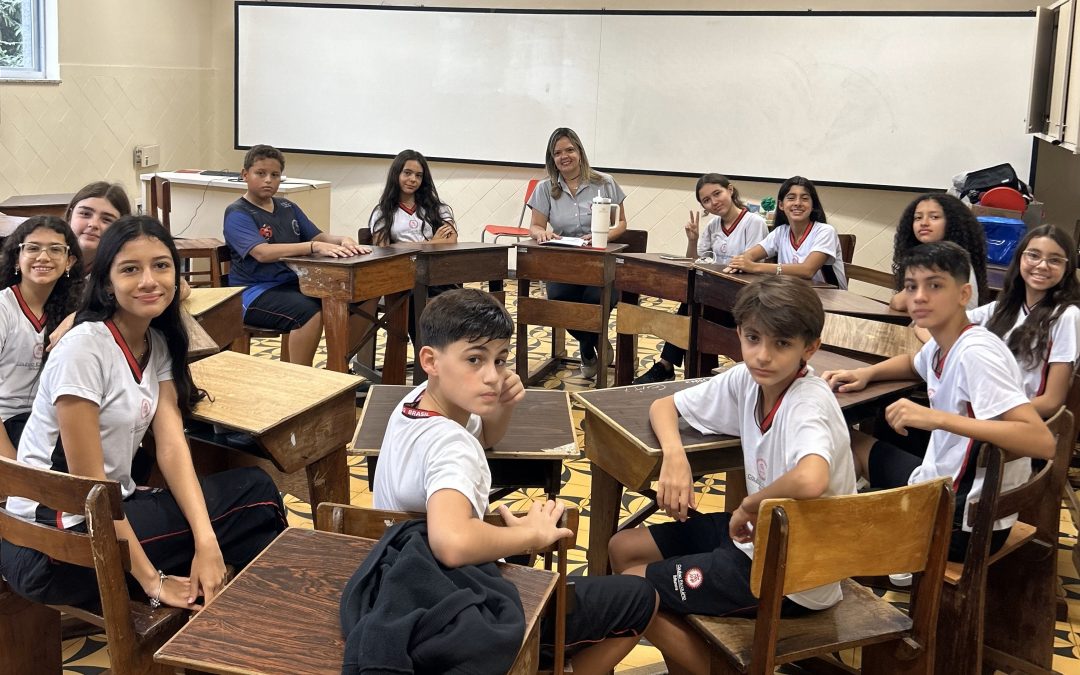
Living Values: the awakening of new leaders
Piarist Fathers of Governador Valadares. Minas Gerais/Brazil
Adolescence is crucial for developing social and emotional skills, including leadership. From 11 to 16 years of age, young people begin to form their identity and relate in a more complex way to the world around them. In this context, developing leadership skills is critical, not only for the personal growth of adolescents but also for building a more collaborative and responsible society. In line with the pedagogy of St. Joseph Calasanz, which emphasizes the integral formation of the human being, the proposal of the Global Education Pact, which seeks to join efforts to ensure a comprehensive and inclusive education, and the Pastoral Pedagogical Political Project of the Pious Schools, we created the “Ibiturunic Leadership” Project.
The project was designed in 2017 with the primary objective of developing leadership skills essential for the formation of the 21st-century human being, including effective communication, emotional intelligence, adaptability and flexibility, critical thinking and problem solving, collaboration and teamwork, innovation and creativity, social responsibility and ethics, digital skills, monitoring, and talent development.
The initiative aims to train students to act as thinking citizens, promoting democracy, critical thinking, responsibility, and empathy in a fair and responsible manner. It arose from the need to give students a voice and allow them to contribute directly to the school’s academic, social, and structural issues.
For better organization, planning and execution, the operational part of the project was divided into six stages: self-knowledge and self-confidence (academic leader, artistic leader, sports leader and pastoral leader), teamwork, effective communication, conflict resolution and decision making, inauguration ceremony and monthly meetings with the coordination and pedagogical orientation.
The pedagogical team built a calendar of meetings with the leaders to evaluate the pedagogical work throughout the school year. In addition to the official meetings to listen and collect points for improvement in each course’s pedagogical work, the leaders also actively assist the pedagogical team in the institution’s events.
The project has a universal application and is easily adaptable to the reality of each educational institution. In addition, it requires a minimum number of resources and has many possibilities for embedding in the academic community.
The project demonstrates how these skills can be cultivated practically and effectively, aligning the National Core Curriculum (BNCC) competencies and the principles of the Global Education Pact and the pedagogy of St. Joseph Calasanz.
Piarist education, which is based on the integral formation of the human being, is essential in this context, as it promotes academic development and the formation of critical, responsible, and empathetic citizens. The project strengthens leadership by giving students a voice and encouraging them to participate actively in school life. It contributes to the construction of a more united and collaborative school community.
Thus, by investing in the formation of young leaders, we are preparing a generation capable of facing future challenges with ethics, responsibility, and a strong sense of justice. Piarist education, therefore, becomes a fundamental pillar for constructing a more just and caring society, where each individual is valued and has the opportunity to contribute to the common good. Through initiatives such as the Ibiturúnico Leadership Project, we can glimpse a future where leadership is exercised with empathy and commitment, reflecting on the values we wish to see in our society.
Annex: Reference videos of the project
Testimony of Isabela Mac
Academic leadership elections
Presentation of the project to the community
