Implementation of an integral accompaniment policy in the Nazareth Province.
F. Juan Carlos Gómez. Martha Díaz Cabrera. Leidy Lorena Rios. Provincia Nazareth
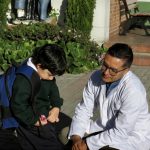
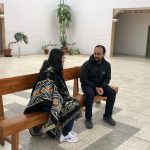
Objective: To provide listening spaces so that children and young people can find tools that allow them to grow in all dimensions of their lives.
Definition: It is a meeting space where, through dialogue, children are helped to discover tools that enable them to grow in all their dimensions by embracing their lives.
STRUCTURE OF THE EXPERIENCE
Who are we?
Formal education works of the Nazareth Province include six schools in Colombia, three in Ecuador, and three in Peru.
What do we do?
In the Nazareth Province, various forms of accompaniment have enjoyed a special appreciation and a broad scope within the province.
And a broad field within our ministry.
Besides being a culture, it is a true gift that the Lord has given us, which is expressed in many workshops, courses, talks, and documents. Among the latter is a very valuable provincial text, the Policy of Integral Accompaniment (PAI).
How do we do it?
Integral Accompaniment teams are structured by level, with the participation of course directors/tutors, pastoralists, school counselors and coexistence coordinators/inspectors, who meet periodically with the methodology of case studies of children, seeking to understand the interior and the reality of each of the children and young people, generating equality of criteria in the accompaniment process.
Different training spaces are developed to integrate the policy into our educational actions. We have support leaders who promote the dissemination and knowledge of the policy at the local level.
Records are kept of the different accompaniments provided to students.
We have developed guiding instruments to structure the teams, alongside other resources addressed in our Calasanz pedagogy congresses, as well as the creation of a platform to consolidate accompaniment information.
Among the positive aspects of the implementation of the policy we find the openness to accompany students, the training of educators, the adjustment of most schools to generate space for meetings in the school schedule, teamwork to accompany students, having school counselors where there were none, among other relevant aspects that have been presented to us by the difference of contexts and countries.
One of the difficulties we have encountered is understanding the policy, due to the high turnover of educators in several of our works, and due to legislative issues, which prevent us from allocating time for meetings more frequently in some works.
The most significant changes in the implementation that have been made have been to be able to have schedules for the meetings and to guarantee that all those summoned were present; for this purpose, the guidelines for the teams were built, allowing clarity both in the functions of the team and the aspects of analysis. However, we are still in the process in some countries.
Where are we heading?
We have established a provincial team that reviews the development of accompaniment in progress, follows up on its implementation, and articulates the scope and impact of the integrated management system. Additionally, this team consolidates a platform for recording accompaniment in all schools.
In Ecuador, we are moving forward with the development of the policy by establishing a comprehensive support team at the three construction sites.
In Peru, we are currently in the training phase of the policy with educators and students. Although the accompaniment is evident in school dynamics, we seek to establish a consistent structure to ensure processes and institutional culture.
For two years we have been seeking to continue growing in the line of accompaniment, for this we are characterizing the Piarist Personal Accompaniment as a transversal axis in the process and in the development of the identity of each of the students, promoting actions of personal accompaniment that take care and untie the dynamisms of their knowledge and discernment, to assume better the reality that challenges each of our students. In this way, we continue to grow in response to the policy in the Province, addressing the needs and realities of the children and young people in our care.