
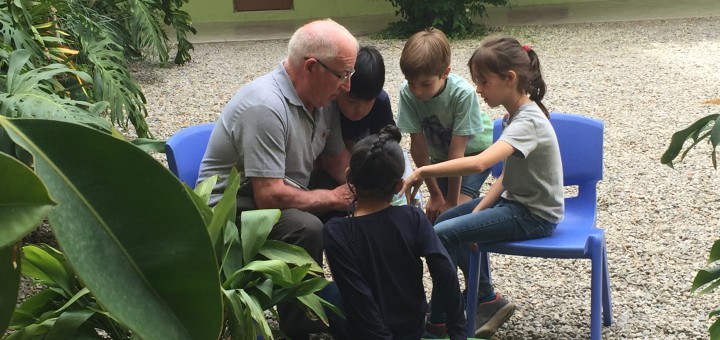
Education beyond school hours
Xavi Canosa y Lluc Capdevila. Escola Pia Catalunya
In an increasingly complex and diverse world, education cannot be limited to school time or classroom walls. This reflection is in the vision of the Escola Pia de Catalunya project, a network composed of 20 schools, the Camins Fundació foundation, and the leisure education organization Lleure Jordi Turull; which works to offer a comprehensive, inclusive, and quality education. With the idea of Marina (2024), quoting an African proverb, “it takes a tribe to educate a child”, we promote collaboration between all agents of the educational community to ensure that every child has equal opportunities to develop fully.
Comprehensive education: beyond the classroom
Non-formal education, which includes activities such as noon time, free time, extracurricular activities, sports, pastoral and participatory activities, plays a fundamental role in developing social, emotional, and civic competencies. As Dewey (1916) stated, “education is not preparation for life; it is life itself”. In this line, at Escola Pia de Catalunya, we believe every interaction, whether in the playground or during an extracurricular activity, is a significant learning opportunity. For this reason, we want to show different spaces of intervention and presence that complete and reinforce our educational mission.
Noon time
In Catalonia, noon time is not considered school time. Therefore, the management, training, and activity of this time and the responsible monitors fall on the school. At Escola Pia de Catalunya, we consider lunchtime as a daily opportunity to offer an experiential education and another space to work on our students’ integral education and promote coexistence, inclusion, and autonomy at cultural, social, recreational, and habit levels.
Promoting an enriching midday time through free play, dynamic spaces, workshops, or accompaniment for autonomy in the dining room promotes intergenerational coexistence and daily learning.
At the same time, to integrate a work methodology and pedagogical accompaniment with the values of Escola Pia de Catalunya, the monitors responsible for lunchtime take internal training, during which they are provided with tools for their task as educators.
Socio-educational and social mentoring programs
One of the pillars of our strategy is the development of socio-educational programs that seek to break down structural barriers, such as the glass ceiling or inequalities of socioeconomic origin. Social mentoring, a key project in our network, connects university and vocational training students with students in vulnerable situations. This accompaniment not only strengthens the self-esteem and future expectations of young people but also promotes the social commitment of the mentors.
As Paulo Freire (1970) points out in his work Pedagogy of the Oppressed, “true education is praxis, reflection and action of man on the world to transform it”. This transformation is evidenced in the success stories of students who, thanks to these programs, have gone on to higher education or have found job opportunities they previously considered unattainable.
Activities include participation, community, and work with families.
Another backbone of our model is families’ active participation. The 20 school family associations (AFA) are organized jointly to think and carry out joint actions.
Through the Tables of Presence (Taules de Presència) active in each of our presences, we aim to create a meeting place for people, institutions, organizations, communities, and groups that make up Escola Pia de Catalunya and its environment (neighborhood, town, city). The main objective of the Table of Presence is to constitute a space that facilitates joint work to strengthen the Piarist community in a territory and to facilitate socio-educational projects that make it grow in value.
Leisure education, sports, cultural and pastoral activities: values in action.
Leisure education, through afternoon extracurricular activities, esplais and groupings, or summer camps, has a fundamental role in the integral development of children and young people. These spaces offer the opportunity to carry out activities that children and young people like the most in a playful way, but without forgetting the pedagogical component and the transmission of values.
While extracurricular activities are carried out after school hours, complementing the students’ daily activities, summer camps offer recreational and pedagogical alternatives during weekends or school vacations. This non-formal education reinforces academic training and provides a safe and enriching environment where children and young people can grow as individuals committed to their community and society.
In this context, the immense work done by our volunteers in all our presences and at the international level is worth mentioning. The volunteer character is often generated through the sense of belonging that the participants and responsible volunteers have.
Challenges and opportunities
Implementing education beyond school hours is not without its challenges. These include the need for sufficient human and financial resources and coordination between the different actors involved. However, it also represents an opportunity to rethink the role of the school in today’s society and to build a more committed and supportive educational community.
Conclusions
At Escola Pia de Catalunya, we firmly believe that education is a community process. Collaboration between the school, families, leisure organizations, and society in general is fundamental to guarantee that all children have the same opportunities for development and to network the different institutions. As Montessori (1949) expressed, “the greatest success for a teacher is to be able to say: the children now work as if I did not exist.” This ideal is only possible if education is conceived as a shared task.
In short, a comprehensive education beyond school hours is necessary to form critical, committed, and caring citizens. From our experience, we invite other educational communities to reflect and act together to make this transforming model a reality.xavi.canosa@escolapia.cat y lluc.capdevila@escolapia.cat
References
Dewey, J. (1916). Democracy and Education. Macmillan.
Freire, P. (1970). Pedagogía del oprimido. Siglo XXI.
Marina, J. A. (2004). Aprender a vivir. Ariel.
Montessori, M. (1949). The Absorbent Mind. Holt, Rinehart and Winston.
