Financial Literacy Research Center
Cristóbal Colón University. Veracruz, Mexico
Elena Moreno García. Directora. elenam@ucc.mx
The importance of financial literacy
Young people face an increasingly complex economic and financial world. To cope with sophisticated financial products, the possibility of facing financial crises, and the changing pension system, they need to develop competencies that will enable them to make the best decisions about their finances and help them achieve long-term financial stability and well-being.
An essential indicator of our ability to make financial decisions is our level of financial literacy (Lusardi, 2019). The Organization for Economic Co-operation and Development (OECD, 2020) defines financial literacy as the combination of knowledge, skills, attitudes, and behaviors needed to make sound financial decisions. There is evidence from around the world that young people and women, the poorest, the least educated, and older adults have the lowest levels of financial literacy.
Objective of the Center for Research in Financial Literacy
The objective of the Financial Literacy Research Center at Universidad Cristóbal Colón is to develop high-level research on the ability of people to make personal financial decisions based on the economic information available to them. With emphasis on the Southeast region of Mexico, the research developed in this center also analyzes the education and financial literacy of the population, its relationship with socioeconomic and demographic variables, as well as the significant incidence of other variables, such as socialization, in the knowledge, behavior, and attitude regarding finances.
Who are we?
The research team of the Center for Research in Financial Literacy is formed by five PhDs, professors of the Universidad Cristóbal Colón in Veracruz and members of the National System of Researchers of Mexico, whose lines of research are the analysis of financial behavior and well-being, financial education, financial literacy related to energy, the determinants of financial inclusion, and retirement planning, among others. Its work also includes training new researchers, liaising with researchers from other research centers and universities, as well as disseminating the results of its research and organizing academic events.
https://www.ucc.mx/quienes-somos/
Commitment to financial education
Financial education effectively increases financial knowledge and even improves economic and financial behavior and habits. In this sense, financial education taught in schools generates benefits not only for students but also for teachers and, even through children, improves parents’ financial habits, especially in poor households (Frisancho, 2023).
Researchers at the Center for Research in Financial Literacy have joined the work of training in financial education by giving students, teachers and staff of both the University and the school, courses and workshops on savings, investment, retirement planning, credit, insurance and risks; attracting the Global Money Week event to the institution and designing a program in financial education for students of all levels of the Cristobal Colon Study Center.
First International Congress on Financial Literacy
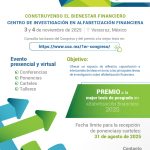
The First International Congress on Financial Literacy, organized by the Financial Literacy Research Center of the Universidad Cristóbal Colón in Veracruz, Mexico, proposes a space for reflection, training, and exchange of ideas around the main lines of research on financial literacy.
This hybrid event, which will take place on November 3 and 4, 2025, at the Campus Calasanz of the Universidad Cristóbal Colón in Veracruz, Mexico, seeks to be a space for presentation and discussion of research papers, of theoretical and practical relevance, that both professors and students in the line of financial literacy have carried out.
We would be delighted if you participated free of charge in the virtual modality for collaborators of the Pious Schools.
https://www.ucc.mx/1er-congreso/
Contacto
Elena Moreno García
Director of the Financial Literacy Research Center
elenam@ucc.mx
References
Frisancho, V. (2023). Spillover Effects of Financial Education: The Impact of School-Based Programs on Parents. Journal of Financial Literacy and Wellbeing, 1(1), 1–16. https://doi.org/10.1017/flw.2023.2
Lusardi, A. (2019). Financial literacy and the need for financial education: evidence and implications. Swiss Journal of Economics and Statistics, 155:1. https://doi.org/10.1186/s41937-019-0027-5
OECD (2020), OECD/INFE 2020 International Survey of Adult Financial Literacy.