
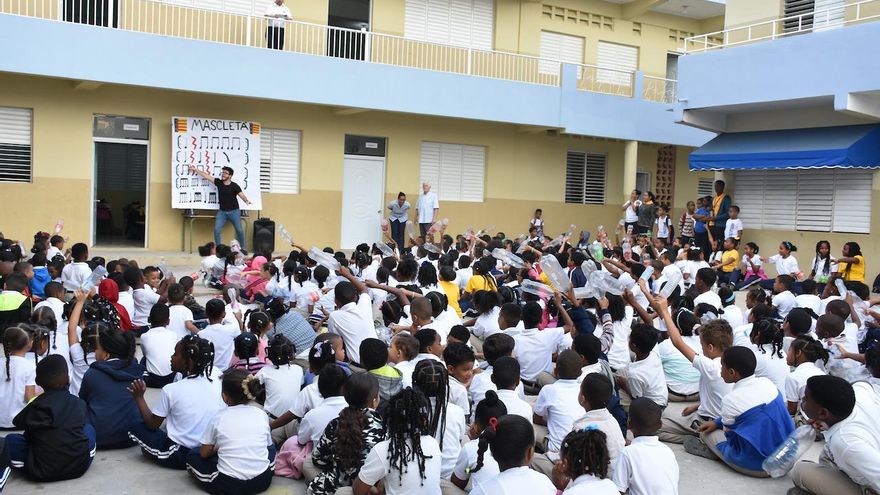
The calasanzian extended day school
Piarist School – La Romana (Dominican Republic)
The Calasanz La Romana school comprises three educational centers: Calasanz San Pedro School, Calasanz San Eduardo High School, and Calasanz Polytechnic. The school has around 1,500 students at all levels of formal pre-university education, in an extended day program, an educational policy of the Dominican Ministry of Education (Ord. 01-2014), which constitutes an opportunity to strengthen comprehensive quality education in key Calasanzian areas. At the end of their schooling, students receive careful academic and professional technical training to continue their undergraduate studies and/or enter the workforce, depending on the technical degree obtained (e.g., Tourism, Computer Science, Nursing, Audiovisual and Entertainment), covering the following dimensions of the human being.
Spiritual Dimension
To foster personal growth in faith and service to others through various activities of evangelization and pastoral care, such as continuous prayer, volunteering, community service, retreats, Calasanz Movement, Calasanz unites us, and the celebration of the sacraments (Sacraments of Initiation).
Academic and Humanistic Dimension
Providing quality education with a professional technical output through Formal Education (regular classes with a focus on competencies, interdisciplinary projects), technical training (practical skills workshops: computer, cooking, nursing, tourism), vocational guidance, employment, and the use of ICT in the teaching-learning process.
Physical and Artistic Development Dimension
Promotes physical health and the development of healthy and creative lifestyles through various activities, including soccer, volleyball, basketball, ballet, marching band, inter-school competitions, theater, drawing and painting workshops, music, and artistic presentations and exhibitions.
METHODOLOGY
– Competency-based learning.
During the last three years of schooling, students select a professional degree that provides them with technical training to ensure their effective integration into production and/or microenterprise entrepreneurship.
The technical training is complemented by academic training in accordance with the curriculum proposed by the Dominican Ministry of Education. They have systematic workshops and, in the last year of schooling, they attend the corresponding work center with which the school has an agreement.
– Integral Approach.
A holistic approach is promoted, encouraging active participation from students, fostering teamwork, problem-solving, and projects organized by area or department before the start of the year, with approval from the management team for improved organization.
Volunteer and teamwork:
Through mandatory social work, students propose a community or public institution where they can contribute with their volunteer work (nursing home, civil defense, voluntary military service, others).
The preparation and training of volunteers in the Calasanz Movement are conducted by teachers and collaborators who lead the group dynamics in stages, outside of class hours.
– Continuous Evaluation: Monitoring and follow-up of students’ progress and adjustment of pedagogical strategies based on reports received and evaluation by the management teams.
Expected results
– Integral Development
Those students:
Internalize their faith, have significant experiences of encounter with Christ, deepen the meaning of their existence, their dignity as children of God, and promote Christian values.
Be critical, creative, and supportive, and have a vision for the reality that surrounds them, contributing to the care of the typical home.
Possess a solid humanistic, academic, and technical professional formation.
– Social Commitment:
Assume a greater commitment, participate in volunteer activities and community service, and offer solutions to social problems.
– Creativity and Expression:
Express themselves through art, sports, healthy lifestyle habits, and positively occupy their free time.
Sustainability over Time
– Through continuous training and Calasanctian induction of all staff.
– Motivation and formation of the student body to assume, as young leaders, the proposed works and activities.
– Search for financing to guarantee the continuity of the project through donations and key alliances.
– Effective communication: Dissemination of the achievements and challenges of the experience.
Social and Educational Relevance
– Reduction of school dropout rates.
– Improved academic performance.
– Contribution to community development: Positive impact on the social environment.
CONCLUSION:
The extended day in Calasanzian key offers more time to deepen the formation in values and faith by living piety as human and Christian experiences; it helps students to achieve more meaningful learning who can explore various areas of knowledge in a broad and contextualized way which fosters the development of academic and technical skills, as well as critical thinking and creativity, essential in the integral formation of the person.
