
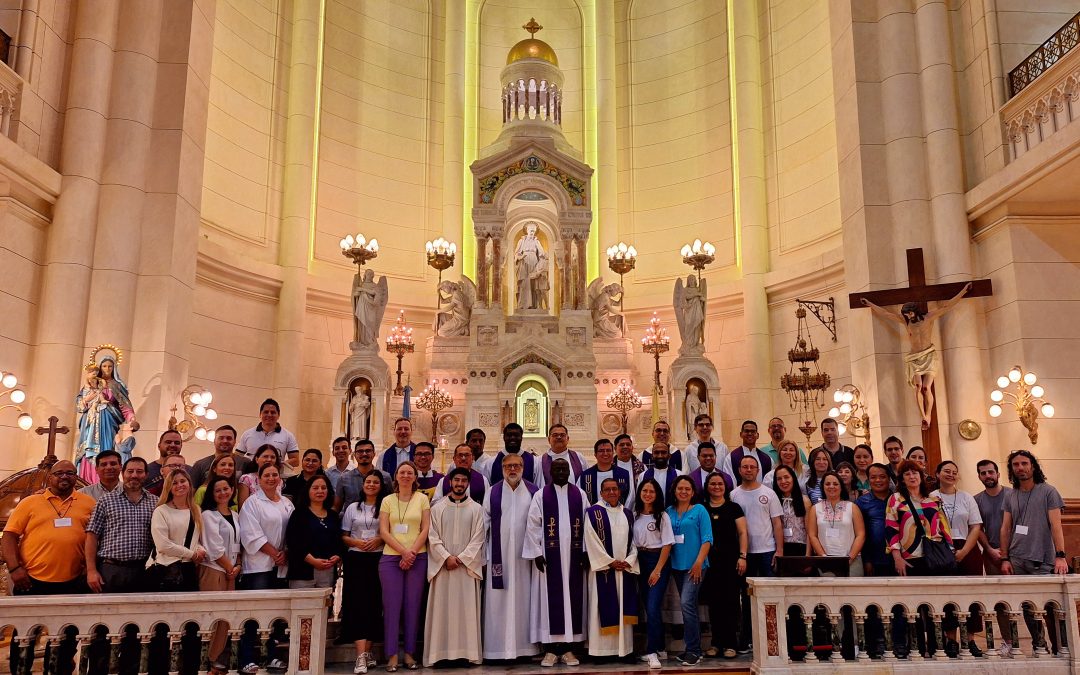
Piarist leadership course
Buenos Aires, from March 11 to 16, 20024
The second phase of the Piarist leadership course ended on Saturday 16 with a day of socializing and sightseeing, with the participation of 49 of the 54 students from 17 districts and 18 different nationalities. The meeting was organized by the members of the General Secretariat for an irreplaceable ministry who met on the 17th and 18th to follow up on the Road Map of the Sexennium. The course was in Spanish with simultaneous translation into English.
The program of the course was articulated around 5 core topics:
- Integral education. Piety and letters.
- Christian Piarist Community
- Full time school
- Piarist Leadership
- Educational innovation and change management
The first three topics addressed the Piarist School´s current vision on the Piarist ministry and included organized spaces for dialogue to better understand the topic and adapt it to reality. Thursday and Friday’s topics addressed more operational and management issues in the application of the Piarist educational model.
Each day, participants from different provinces presented a significant innovation experience, successfully applied in their districts.
CHRONICLE OF THE MEETING
Monday, March 11. Integral education in Piety and Letters.
With the celebration of the Eucharist presided by Father General, the second module of the Piarist Leadership Course began at Calasanz School in Buenos Aires.
During the morning, a wide range of challenges regarding integral education were addressed. The opening words were dedicated by Fr. General Pedro Aguado to the 54 educators of schools from all over the Piarist geography. Father General recalled the biblical passage “he who welcomes one of the least of these, welcomes me”, as the cornerstone of our Calasanctian identity, highlighting the role of the Piarist Christian community, “soul of the school”. “In every child in your school is Jesus,” he commented.
For Father General, integral education constitutes one of the treasures of the Order, such as the full time school, “a school where everyone fits”, the Calasanz movement or the education of the poorest. He explained the possibilities of innovating, integrating and evangelizing from the Calasanctian identity, highlighting the Piarist Christian community as the soul of the school. “We Piarists want to generate a community soul,” he said. “Innovating allows us to give new answers from our own Piarist identity and we integrate when we place everything in a complete and organic proposal,” he added.
Sergio Conci led the second part of the morning, dedicated to analyze and share different educational models that address integrality in the perspective of Piety and Letters. Afterwards, Fr. Javier Alonso reflected on the binomial “Piety and Letters”. Ignacio, a Piarist argentinian juniorist, conducted a simple workshop with songs that Calasanz himself sang with his students. Finally, the provinces of Argentina and Chile shared their most innovative pedagogical projects in Piety and Letters.
Tuesday 12: The Piarist Christian Community, key to the Calasanctian identity.
The second day of the course dawned with rain. The Eucharist was presided by Fr. Carles Gil who reminded us that doing good is within our reach. Javier Alonso introduced the second theme: the Piarist Christian community through a dynamic in which the participants shared their faith experience.
In the afternoon, participants had the opportunity to visit different places of the Calasanz School of Buenos Aires, guided by students and teachers of the school. To begin with, they toured the religious community where a painting of Blessed Dionisio Pamplona is preserved from his time as headmaster of this school. Then they visited the more than 100 years old courtyards and galleries, where students study and grow in Piety and Letters. They were also guided through the school museum, which preserves images and objects that narrate the living history of this Pious School.
In the second part of the afternoon, the Province of Mexico shared its project of “sustainability for the care of the common home”, followed by Catalonia, which presented some of its educational innovations, as well as the Province of Brazil-Bolivia. Cristobal Colon University of Veracruz also shared its vision of humanistic education and integral formation. Finally, the group reflected on the best way to promote Christian Community in each Province.
Wednesday 13. Full time schools, key to an integral Piarist education.
An intense day of work began with the celebration of the Eucharist. Sergio Conci, Provincial of Argentina, remarked in his homily that the Pious Schools are like the womb where children can grow spiritually in Piety and Letters. During the morning, the participants, led by the director of the ICCE Nazareth Gladys Cuellar, deepened their understanding of the full-time school. Through different dynamics, the groups reflected on the “ideal” model and worked on the elements it should have.
In the afternoon, the participants received a visit from the children of the Calasanz Home in Buenos Aires, who presented the life of the home and led an activity for the course members. Afterwards, the members of the Central America and Caribbean province shared their educational proposals. Next came Mexicali (Vice-Province of the Californias) and the Province of West Africa, who presented their curriculum and educational community model.
Thursday 14. Piarist Leadership
The Eucharist at the beginning of the fourth day was presided by Fr. Javier Alonso, who remarked, in the light of the readings, that, just as the people of Israel had to remember their origins and the promise that God had made to them in order to reach the goal, so we must do in the history of our Pious Schools. “Remembering our founding origins will give fruitfulness to the Piarist mission,” he said in his homily.
In the morning, Fr. Carles Gil introduced the theme of Leadership from a “synodal perspective”, where we all together lead a Piarist community, and that requires “responsibility, formation and vocation”. “Commanding is different from leading,” Gil explained.
In the afternoon, the attendees participated in a sports workshop guided by students of the “Virtus” project of the Province of Argentina, who are monitors of the Calasanz Movement as well (Iter Calasanz, in Argentina) and some of them, physical education teachers. The games and activities proposed were focused on exercising teamwork. Afterwards, the provinces of Emmaus, Bethany and India presented their experiences.
Later that day, we shared an artistic evening prepared by the community of the Calasanz School of Buenos Aires. First, there was a tango show and some participants were encouraged to learn how to dance it. Then, during dinner, the juniorists of the argentinian province presented a wide variety of folk songs from their country, accompanied by young people from Iter Calasanz who performed the typical dances of those different places.
Friday. Innovation and change management
Fr. Arnel Cabangunay presided the Eucharist and remarked that “we can know many things, intellectually, but if it does not affect our personal life, our faith life, we cannot give it to the children”. The last day of the course focused on educational innovation and change management with a lecture by Gloria Ruiz, from the Piarist province of Emmaus. Afterwards, the work continued in the Assembly. In the afternoon, the participants were divided into 4 groups to experience different educational proposals by the province of Argentina: Socratic Seminar, EDANI (experience, doctrine and environment at the pre-school level), Trivium and Service Learning. In the second part of the afternoon, educational experiences from Nazareth, Ecuador, Austria and Hungary were shared. Finally, this last working session was closed with a simple sharing of the experience of the meeting.
We share with you a video with some testimonials from the participants. The course will have a third on-line phase and a final work. We hope that the Piarist mission will be strengthened with this initiative of the Piarist Leadership Course.
